

Documentation Index
Fetch the complete documentation index at: https://docs.privy.io/llms.txt
Use this file to discover all available pages before exploring further.
Prerequisites
This hook requires Bridge API keys. If your app does not already have a Bridge account, request access at Bridge and obtain API keys. Then, enable the bank transfer method on the Account Funding page in the Privy dashboard. Enter your Bridge API keys when prompted, and save.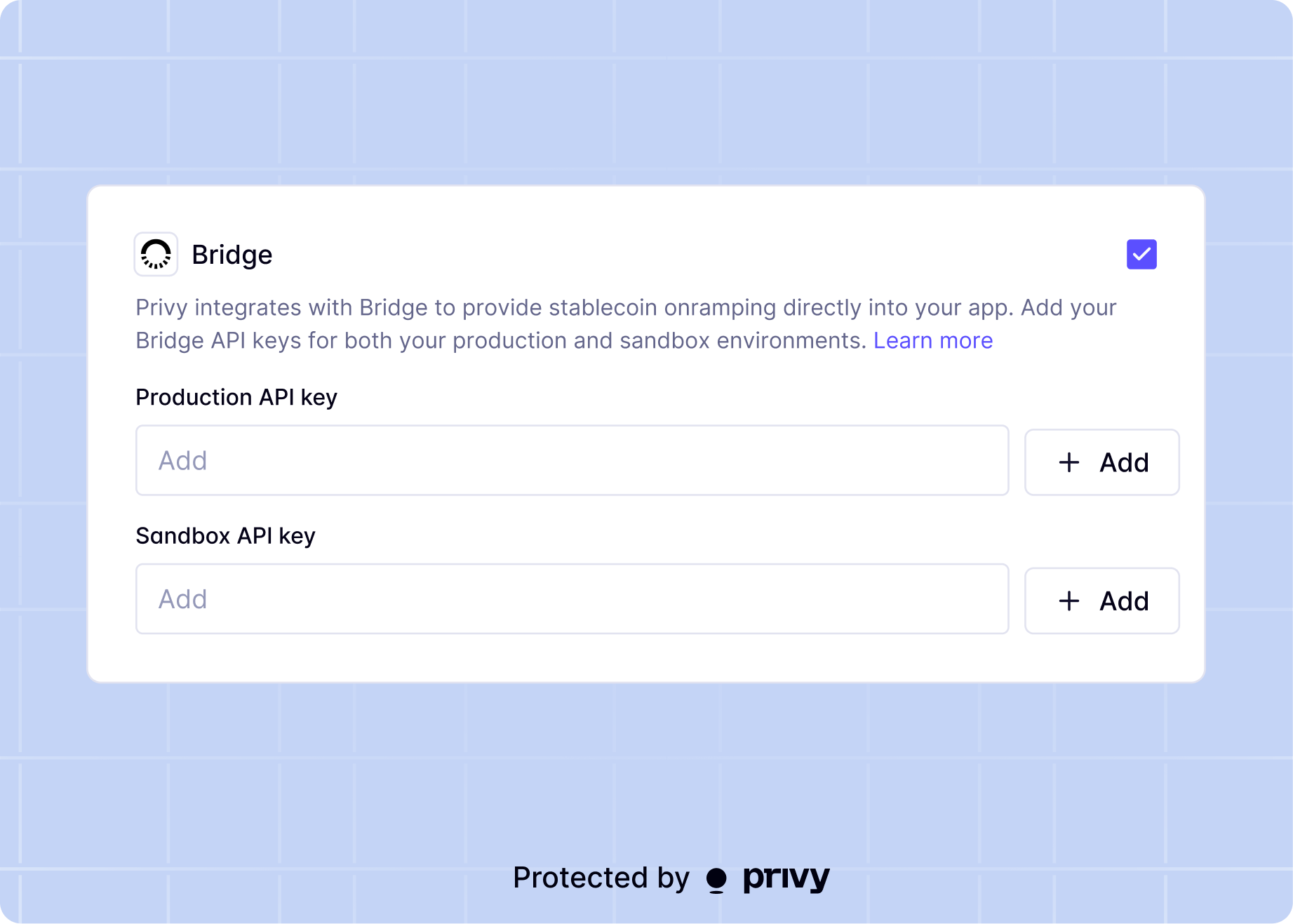
Overview
Privy provides auseFundWalletWithBankDeposit hook in @privy-io/react-auth that starts a bank deposit funding flow in the Privy modal.
Your app can use this hook to let authenticated users fund a wallet by transferring fiat from a bank account. The user completes KYC verification, then receives virtual account deposit instructions for a bank transfer (ACH, wire, or SEPA). The onramp provider converts the fiat deposit into crypto and delivers it to the destination wallet.
Access the hook
Import and initializeuseFundWalletWithBankDeposit:
Start a bank deposit flow
Callfund with source currency options, a destination wallet, and an onramp provider.
destination.chain accepts a CAIP-2 identifier (for example, eip155:8453 for Base or
solana:mainnet for Solana).Parameters
fund accepts an object with the following fields:
| Parameter | Type | Description |
|---|---|---|
source.assets | ('usd' | 'eur' | 'mxn' | 'brl' | 'gbp')[] | Required. The list of fiat source currencies your app allows. Must be non-empty. |
source.defaultAsset | 'usd' | 'eur' | 'mxn' | 'brl' | 'gbp' | Optional. The source currency pre-selected when the flow opens. Falls back to the locale currency, then to the first item in source.assets. |
destination.asset | 'usdb' | 'usdc' | 'usdt' | 'dai' | 'pyusd' | 'eurc' | Required. Destination crypto asset for this flow. |
destination.chain | `${string}:${string}` | Required. Destination chain in CAIP-2 format. |
destination.address | string | Required. Destination wallet address for deposited funds. |
provider | 'bridge' | 'bridge-sandbox' | Required. The onramp provider that processes the bank deposit. |
Return value
fund returns a Promise that resolves to an empty object ({}) on success. The Promise resolves once the user completes the flow and receives virtual account deposit instructions.
Error handling
fund rejects on invalid configuration, failed KYC verification, or incomplete flows. Common error cases include:
source.assetsis empty- the onramp provider fails to create a customer or virtual account
- the onramp provider rejects the user’s KYC verification
- the user closes the flow before completing KYC or receiving deposit instructions
try/catch and show clear UI feedback.
Complete example
Use with deposit addresses
Apps that already use deposit addresses to receive funds on behalf of users can pass that address directly as thedestination.address in the fund call. The bank deposit flow delivers the converted crypto straight to the deposit address, letting your app credit the user’s account through your existing settlement logic.
The
destination.address does not need to be the user’s own wallet. It can be any valid address
your app controls, such as a per-user deposit address generated by your backend. Set
destination.asset and destination.chain to match the crypto asset and network that the deposit
address expects as input.