

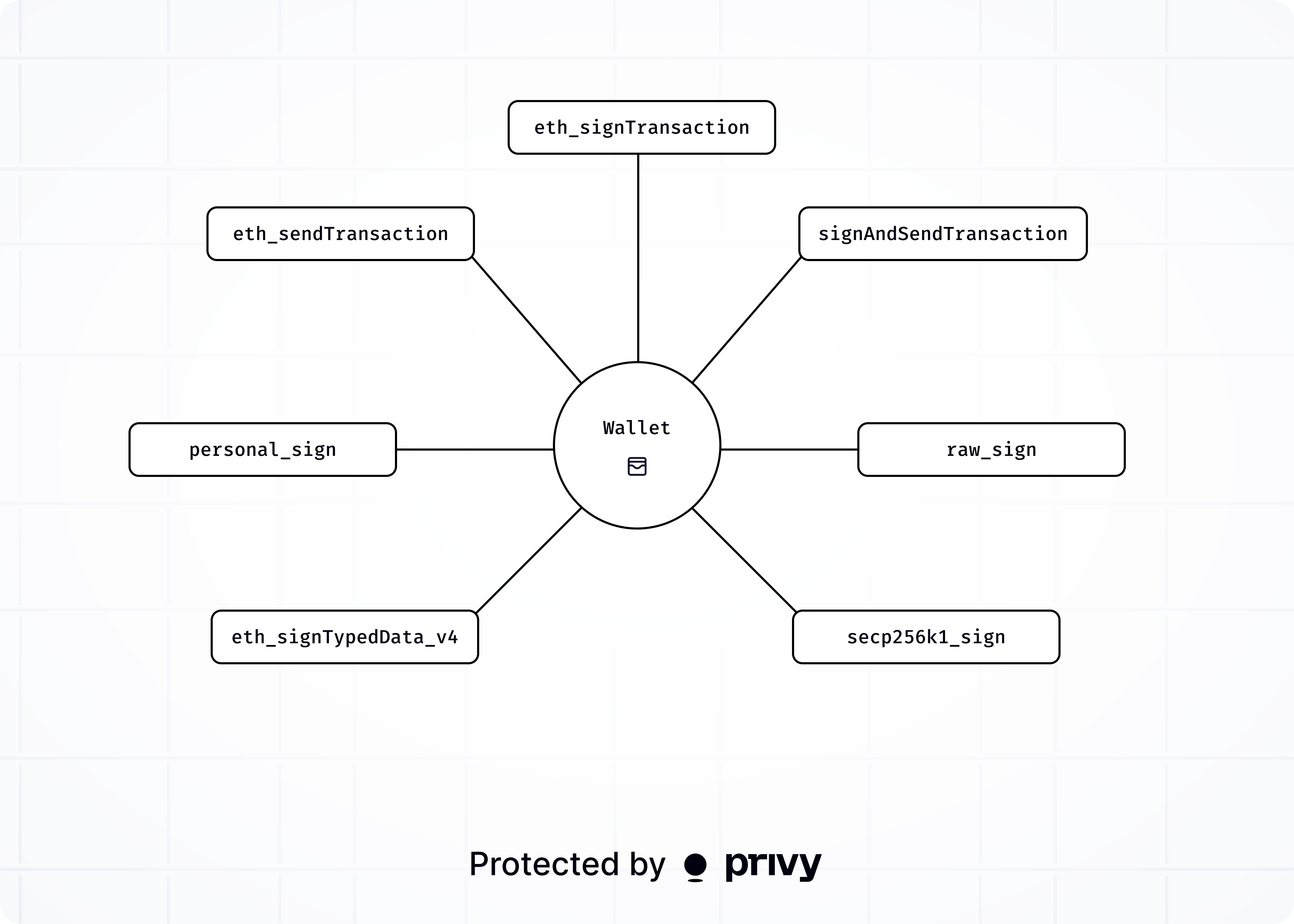
Privy enables you to interface directly with wallets by sending JSON-RPC requests or directly requesting signatures over messages and transaction payloads. This allows you to use Privy for low-level key management and achieve any onchain use case with Privy wallets. RPC splash

Taking actions with wallets

To take an action (such as a transfer or swap) with a wallet in Privy, there are two high-level approaches.
IntegrationFunctionalityRecommended for
Wallet action APIsExecute common onchain flows such as transfers, swaps, DeFi, and more via a simple, intuitive interface. Privy handles the onchain complexity.Most use cases
Low-level RPCCompute raw signatures and execute EVM and SVM JSON-RPC requests. Requires developers to construct their own transaction payloads and facilitate multi-transaction flows.Custom use cases and lower-level flows
While using wallet actions is generally recommended for most use cases, your application may need to interface with wallets directly for more custom functionality. This is fully supported in parallel with wallet actions via RPCs.

Using RPCs

For Tier 3 chain types, Privy supports the standard set of JSON-RPC methods for that chain type (e.g. EIP1193 for EVM) – including message signing, transaction signing, and transaction broadcasting. View guides for using each of these JSON-RPC methods with Privy in the left navigation. For Tier 2 and Tier 1 chain types, Privy supports using the wallet’s private key to sign custom payloads – allowing you to construct transactions of your choosing and sign them with the wallet. Your application can then broadcast this signed transaction to the chain to execute it.