> ## Documentation Index
> Fetch the complete documentation index at: https://docs.privy.io/llms.txt
> Use this file to discover all available pages before exploring further.
# Wallet actions
> Wallet action APIs for transfers, swaps, and DeFi interactions with asynchronous processing
Privy's API provides abstractions for common actions taken by a wallet, including transfers, swaps, interactions with DeFi vaults, and more. These are called **wallet action APIs**.
At a high-level, **wallet action APIs** abstract away the complexity of constructing blockchain transactions from scratch, managing blockchain state, and facilitating actions that may require multiple transactions or steps. Your service just integrates a simple API for wallet actions, and Privy handles the onchain complexity.
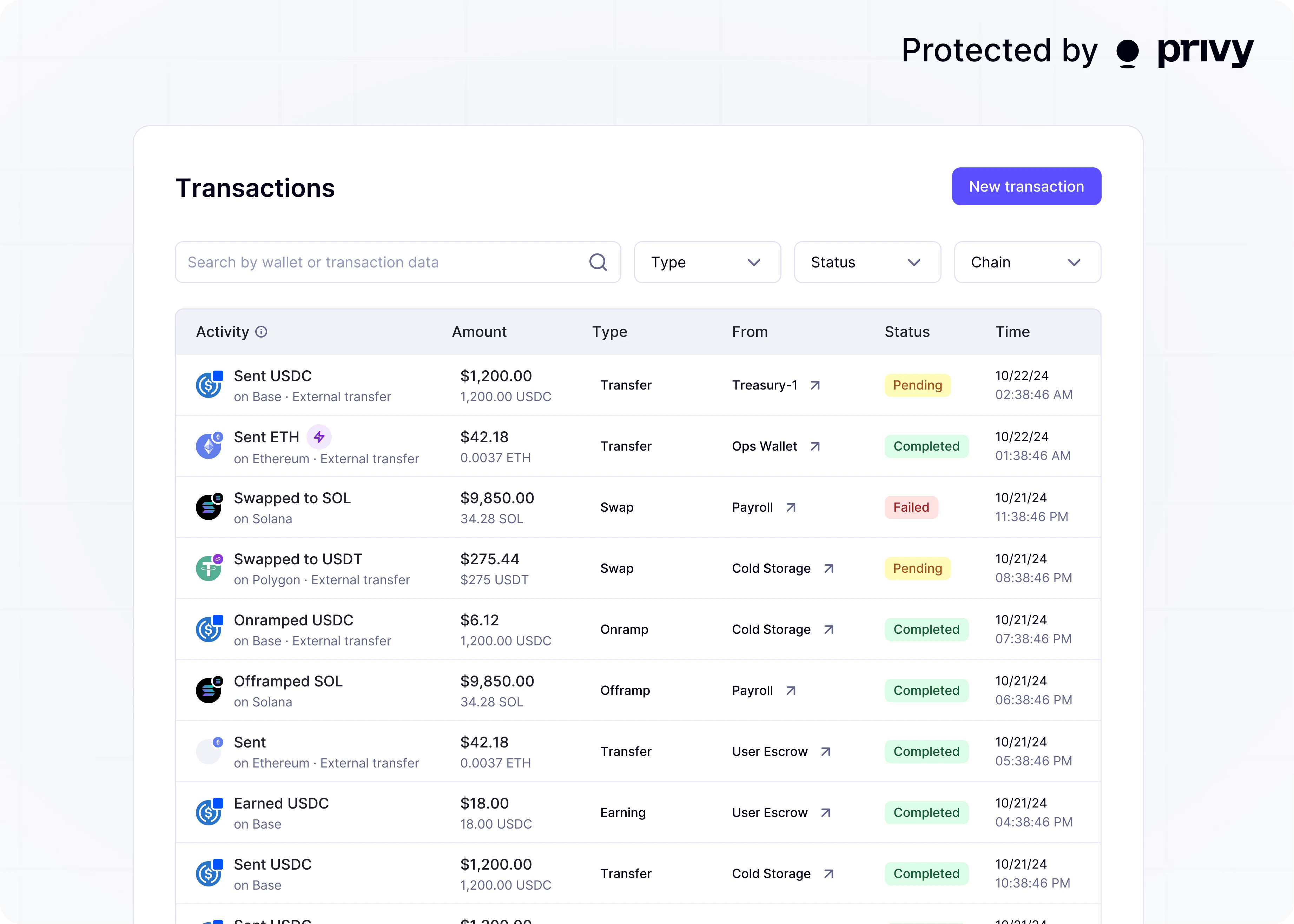 ### Taking actions with a wallet
To take an action (such as a transfer or swap) with a wallet in Privy, there are two approaches.
| Integration | Functionality | Recommended for |
| ----------------------------------------------------------------- | ------------------------------------------------------------------------------------------------------------------------------------------------------------------------- | -------------------------------------- |
| [Wallet action APIs](/wallets/actions/overview#available-actions) | Execute common onchain flows such as transfers, swaps, DeFi, and more via a simple, intuitive interface. Privy handles the onchain complexity. | Most use cases |
| [Low-level RPC](/wallets/using-wallets/ethereum/sign-a-message) | Compute raw signatures and execute EVM and SVM JSON-RPC requests. Requires developers to construct their own transaction payloads and facilitate multi-transaction flows. | Custom use cases and lower-level flows |
Generally, we recommend using the abstracted **wallet action APIs**, which are listed below.
### Available actions
The current set of abstracted wallet actions APIs includes the endpoints below. All endpoints begin with the route `/v1/wallets/{wallet_id}/`, followed by the slug.
| Action | Slug | Description |
| ---------------------------------------------- | ---------- | ---------------------------------------------------------------------------------------------------------------------- |
| [Transfer](/wallets/actions/transfer/overview) | `transfer` | Executes a transfer of stablecoins (USDC, USDT, USDB, EURC) or native tokens (ETH, SOL, POL) on EVM chains and Solana. |
| [Swap](/wallets/actions/swap/overview) | `swap` | Swaps one asset in the wallet for another via [Uniswap](https://app.uniswap.org/). |
| [Earn](/wallets/actions/earn/overview) | `earn` | Deposit into yield-generating vaults, withdraw with accrued yield, and claim reward incentives. |
### Wallet action lifecycle
When your application executes a wallet action via one of the endpoints listed above, Privy creates a wallet action resource to model the action and returns it in the API response. Your application can inspect the wallet action resource to get the action's `type`, `status`, and `steps`.
For a detailed breakdown of action statuses, step types, and step-specific statuses, see the [wallet action lifecycle](/wallets/actions/lifecycle) page.
Your application can [fetch the wallet action resource](/wallets/actions/status) for a given action or subscribe to [webhooks](/wallets/actions/webhooks) on wallet action status updates.
### Authorization signatures
For wallets with an [owner and/or signers](/controls/authorization-keys/owners/overview), requests to wallet actions APIs require an [authorization signature](/controls/authorization-keys/using-owners/sign/utility-functions) over the request. This signature is verified by the Privy TEE to authorize request execution.
### Gas management
Wallet action APIs support two gas payment modes:
**App pays (default):** Privy will **optimistically sponsor gas** for transactions if your application has [gas sponsorship](/wallets/gas-and-asset-management/gas/overview) enabled with sufficient credits. If gas sponsorship is not enabled, the wallet must pay gas from its own native token balance.
**User pays:** Gas fees are paid directly from the wallet's USDC or USDT balance, with no ETH required. Once enabled in the [dashboard](/wallets/gas-and-asset-management/gas/setup), any Transfer API transaction using a supported token on a supported chain will automatically use that token to cover gas fees. This mode is currently only available on the [transfer API](/wallets/actions/transfer/overview).
### Policies
Each wallet action API has its own [method](/controls/policies/overview) in Privy's policy language. For example, to enforce policies on the `/transfer` API, include a rule in the policy with `method: 'transfer'` to apply a rule to the API.
Note that when a wallet action API is invoked, Privy does *not* enforce policy rules for RPC methods that may internally be used implicitly by the wallet action.
As an example, when calling the `/transfer` API, policy rules with methods `eth_sendTransaction` and `signAndSendTransaction` are **not** enforced on those those API calls. Only policy rules with `method: 'transfer'` are enforced.
See Privy's suggested configuration for [allowlisting wallet action
APIs](/controls/policies/overview#allowlisted-rpcs-and-wallet-actions) in policies.
### Taking actions with a wallet
To take an action (such as a transfer or swap) with a wallet in Privy, there are two approaches.
| Integration | Functionality | Recommended for |
| ----------------------------------------------------------------- | ------------------------------------------------------------------------------------------------------------------------------------------------------------------------- | -------------------------------------- |
| [Wallet action APIs](/wallets/actions/overview#available-actions) | Execute common onchain flows such as transfers, swaps, DeFi, and more via a simple, intuitive interface. Privy handles the onchain complexity. | Most use cases |
| [Low-level RPC](/wallets/using-wallets/ethereum/sign-a-message) | Compute raw signatures and execute EVM and SVM JSON-RPC requests. Requires developers to construct their own transaction payloads and facilitate multi-transaction flows. | Custom use cases and lower-level flows |
Generally, we recommend using the abstracted **wallet action APIs**, which are listed below.
### Available actions
The current set of abstracted wallet actions APIs includes the endpoints below. All endpoints begin with the route `/v1/wallets/{wallet_id}/`, followed by the slug.
| Action | Slug | Description |
| ---------------------------------------------- | ---------- | ---------------------------------------------------------------------------------------------------------------------- |
| [Transfer](/wallets/actions/transfer/overview) | `transfer` | Executes a transfer of stablecoins (USDC, USDT, USDB, EURC) or native tokens (ETH, SOL, POL) on EVM chains and Solana. |
| [Swap](/wallets/actions/swap/overview) | `swap` | Swaps one asset in the wallet for another via [Uniswap](https://app.uniswap.org/). |
| [Earn](/wallets/actions/earn/overview) | `earn` | Deposit into yield-generating vaults, withdraw with accrued yield, and claim reward incentives. |
### Wallet action lifecycle
When your application executes a wallet action via one of the endpoints listed above, Privy creates a wallet action resource to model the action and returns it in the API response. Your application can inspect the wallet action resource to get the action's `type`, `status`, and `steps`.
For a detailed breakdown of action statuses, step types, and step-specific statuses, see the [wallet action lifecycle](/wallets/actions/lifecycle) page.
Your application can [fetch the wallet action resource](/wallets/actions/status) for a given action or subscribe to [webhooks](/wallets/actions/webhooks) on wallet action status updates.
### Authorization signatures
For wallets with an [owner and/or signers](/controls/authorization-keys/owners/overview), requests to wallet actions APIs require an [authorization signature](/controls/authorization-keys/using-owners/sign/utility-functions) over the request. This signature is verified by the Privy TEE to authorize request execution.
### Gas management
Wallet action APIs support two gas payment modes:
**App pays (default):** Privy will **optimistically sponsor gas** for transactions if your application has [gas sponsorship](/wallets/gas-and-asset-management/gas/overview) enabled with sufficient credits. If gas sponsorship is not enabled, the wallet must pay gas from its own native token balance.
**User pays:** Gas fees are paid directly from the wallet's USDC or USDT balance, with no ETH required. Once enabled in the [dashboard](/wallets/gas-and-asset-management/gas/setup), any Transfer API transaction using a supported token on a supported chain will automatically use that token to cover gas fees. This mode is currently only available on the [transfer API](/wallets/actions/transfer/overview).
### Policies
Each wallet action API has its own [method](/controls/policies/overview) in Privy's policy language. For example, to enforce policies on the `/transfer` API, include a rule in the policy with `method: 'transfer'` to apply a rule to the API.
Note that when a wallet action API is invoked, Privy does *not* enforce policy rules for RPC methods that may internally be used implicitly by the wallet action.
As an example, when calling the `/transfer` API, policy rules with methods `eth_sendTransaction` and `signAndSendTransaction` are **not** enforced on those those API calls. Only policy rules with `method: 'transfer'` are enforced.
See Privy's suggested configuration for [allowlisting wallet action
APIs](/controls/policies/overview#allowlisted-rpcs-and-wallet-actions) in policies.