> ## Documentation Index
> Fetch the complete documentation index at: https://docs.privy.io/llms.txt
> Use this file to discover all available pages before exploring further.
# Allowlist
**With Privy, you can enable an allowlist for your application to gate access to specific email addresses, phone numbers, and/or wallet addresses.** You can use the allowlist feature to coordinate a beta launch of your product for early-access users, manage an ongoing waitlist, and more!
When you enable an allowlist for your app:
* All existing users will still be permitted to login to your app
* New users must be added to the allowlist by their email address, phone number, or wallet address to be permitted to login
* New users who have not been added to your allowlist will **not** be permitted to login.
Allowlists apply to email, SMS, wallet, and OAuth methods with verified emails only. Login methods
like Telegram and Farcaster are not supported.
## Enabling the allowlist for your app
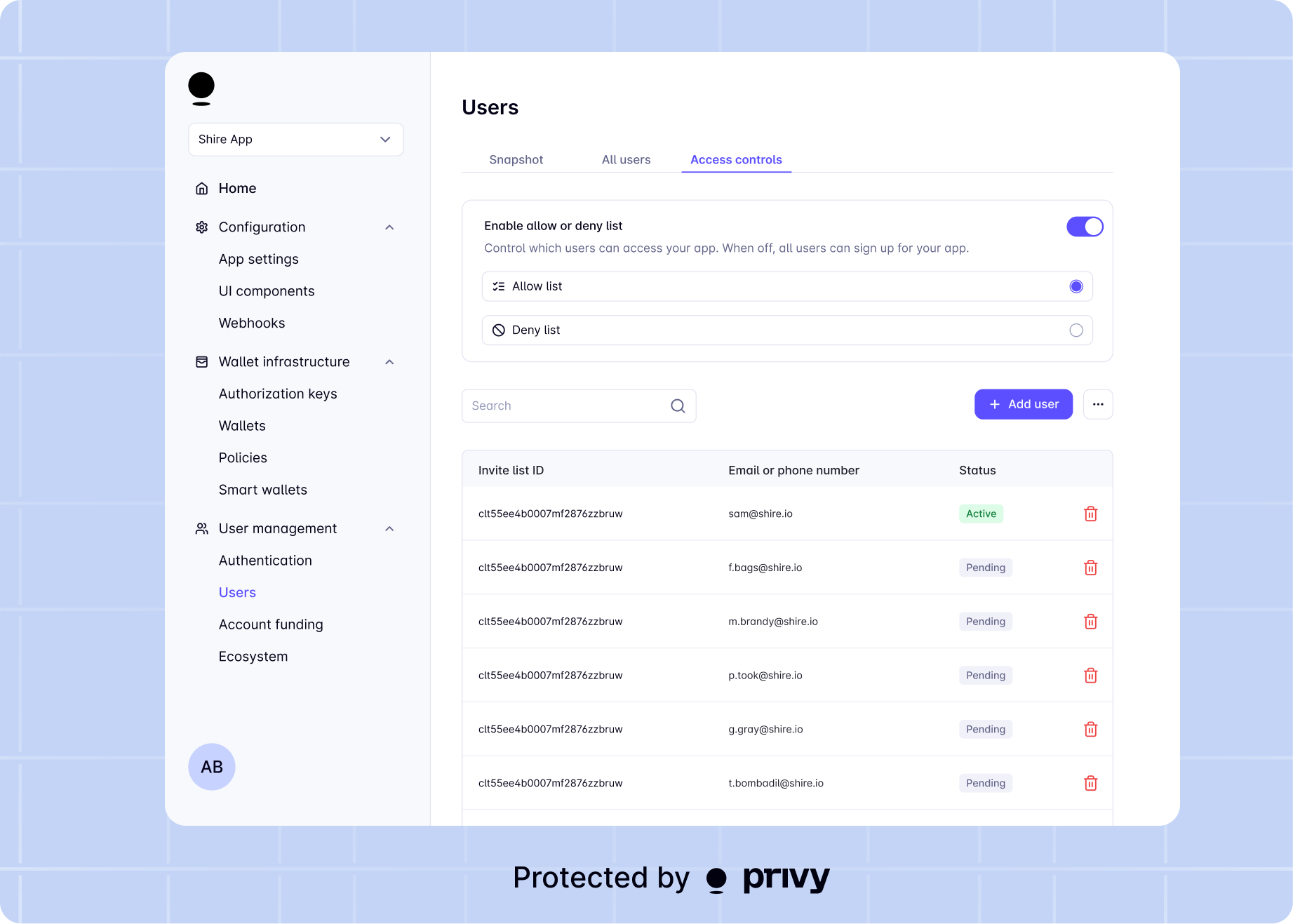
You can enable an allowlist directly from the [Privy developer dashboard](https://dashboard.privy.io). To do so, just navigate to the **Users** page > [Access Control](https://dashboard.privy.io/apps/cm7z7tdvm00oxpsqt25bha0tv/users?tab=access-control) tab of the dashboard and toggle allowlists on.
 ## Managing the allowlist
There are two main ways to manage the allowlist for your app:
* Using the API, you can easily [add users](/user-management/users/managing-users/allowlist#adding-to-the-allow-list), [remove users](/user-management/users/managing-users/allowlist#removing-from-the-allow-list), and [get your current allowlist](/user-management/users/managing-users/allowlist#getting-the-allow-list).
* Using the developer dashboard, you can easily [add and remove users](/user-management/users/managing-users/allowlist#adding-to-the-allow-list) from your app's invite list page.
It's easy to use the Privy API to manage your waitlist with a third party-tool. For instance, if you are using [Airtable](https://www.airtable.com/) to manage your waitlist, you can easily integrate it with Privy.
Check out [this guide](/recipes/dashboard/airtable) for more!
## Adding to the allowlist
Privy allows you to easily add a user's email address, phone number, or wallet address to the allowlist for your app.
Use the `inviteToAllowlist` method from the `apps()` interface to add a user to your allowlist.
```ts theme={"system"}
import {PrivyClient} from '@privy-io/node';
const privy = new PrivyClient({
appId: process.env.PRIVY_APP_ID!,
appSecret: process.env.PRIVY_APP_SECRET!
});
const allowlistEntry = await privy.apps().inviteToAllowlist({
type: 'email',
value: 'batman@privy.io'
});
```
As a parameter to the method, pass an object with the following fields:
The type of account to add to the allowlist.
The identifier of the account to add to the allowlist. Should be the corresponding email address,
phone number, or wallet address.
If the invitation is successful, the method returns an allowlist entry object. If the invitation
fails, the method throws an error.
## Using the REST API
Make a `POST` request to:
```sh theme={"system"}
https://auth.privy.io/api/v1/apps//allowlist
```
In the body of the request, include the following fields:
The type of account to add to the allowlist.
The identifier of the account to add to the allowlist. Should be the corresponding email address,
phone number, or wallet address.
Below is a sample cURL command for adding an email to the allowlist:
```bash theme={"system"}
curl --request POST 'https://auth.privy.io/api/v1/apps//allowlist' \
-u ":" \
-H "privy-app-id: " \
-H 'Content-Type: application/json' \
--data-raw '{
"type": "email",
"value": "user@email.com"
}'
```
A successful response will include the new allowlist entry, like below
```json theme={"system"}
{
"id": "allowlist-entry-ID",
"type": "wallet",
"value": "0xab5801a7d398351b8be11c439e05c5b3259aec9b",
"appId": "your-privy-app-ID"
}
```
## Removing from the allowlist
Privy allows you to easily remove a user's email address, phone number, or wallet address to the allowlist for your app.
Use the `removeFromAllowlist` method from the `apps()` interface to remove a user from your allowlist.
```ts theme={"system"}
import {PrivyClient} from '@privy-io/node';
const privy = new PrivyClient({
appId: process.env.PRIVY_APP_ID!,
appSecret: process.env.PRIVY_APP_SECRET!
});
const removedAllowlistEntry = await privy.apps().removeFromAllowlist({
type: 'email',
value: 'batman@privy.io'
});
```
As a parameter to the method, pass an object with the following fields:
The type of account to remove from the allowlist.
The identifier of the account to remove from the allowlist. Should be the corresponding email
address, phone number, or wallet address.
If the removal is successful, the method returns a confirmation object. If the removal fails, the
method throws an error.
Make a `DELETE` request to:
```sh theme={"system"}
https://auth.privy.io/api/v1/apps//allowlist
```
In the body of the request, include the following fields:
The type of account to remove from the allowlist.
The identifier of the account to remove from the allowlist. Should be the corresponding email
address, phone number, or wallet address.
Below is a sample cURL command for deleting an email from the allowlist:
```bash theme={"system"}
curl --request DELETE 'https://auth.privy.io/api/v1/apps//allowlist' \
-u ":" \
-H "privy-app-id: " \
-H 'Content-Type: application/json' \
--data-raw '{
"type": "email",
"value": "user@email.com"
}'
```
A successful response will include a message, such as:
```json theme={"system"}
{
"message": "Successfully deleted from allowlist"
}
```
If there is no corresponding allowlist entry for the invited account you attempted to delete, the response will include an error.
If a user has successfully logged into your application (e.g. after having been added to the allow
list), you must [delete their user object](/user-management/users/managing-users/deleting-users),
rather than deleting their allowlist entry—to revoke their access.
***
# Getting the allowlist
Privy allows you to easily get the current allowlist for your app.
Use the `getAllowlist` method from the `apps()` interface to get your app's current allowlist. Pass no parameters to this method.
```ts theme={"system"}
import {PrivyClient} from '@privy-io/node';
const privy = new PrivyClient({
appId: process.env.PRIVY_APP_ID!,
appSecret: process.env.PRIVY_APP_SECRET!
});
const allowlist = await privy.apps().getAllowlist();
```
If the request is successful, the method returns an array of allowlist entry objects. Each entry includes an `id`, a `type` describing the type of entry (`'email'`, `'phone'`, or `'wallet'`), a `value` with the corresponding account identifier, and an `appId`.
Make a `GET` request to:
```
https://auth.privy.io/api/v1/apps//allowlist
```
Below is a sample cURL command for getting your current allowlist:
```bash theme={"system"}
curl --request GET 'https://auth.privy.io/api/v1/apps//allowlist' \
-u ":" \
-H "privy-app-id: "
```
A successful response will include an array of your current allowlist entries, like below:
```json theme={"system"}
[
{
"id": "allowlist-entry-ID",
"type": "wallet",
"value": "0xab5801a7d398351b8be11c439e05c5b3259aec9b",
"appId": "your-privy-app-ID"
},
{
"id": "allowlist-entry-ID",
"type": "email",
"value": "user@email.com",
"appId": "your-privy-app-ID"
}
// ...
]
```
***
# Customizing allowlist rejection
If your app has an allowlist enabled, new users who attempt to login with an account not in your allowlist will not be permitted to login to your app.
**You can customize the screen shown to the user when they are denied permission to login, to help contextualize the allowlist within your app.**
To customize this screen, make a `POST` request to
```
https://auth.privy.io/api/v1/apps/
```
In the body of the request, include an field that contains a JSON with the following fields. All fields in this object are optional.
The primary text for the error message you'd like to show your user. Defaults to "You don't have
access to this app".
The secondary text for the error message you'd like to show your user. Defaults to "Have you been
invited?"
The text to show on the error confirmation button. Defaults to "Try another account"
The URL to navigate the user to, when they click the error CTA. Defaults to just closing the
screen on click, instead of navigating the user to another URL.
Below is a sample cURL command for updating the allowlist config:
```bash theme={"system"}
curl --request POST 'https://auth.privy.io/api/v1/apps/' \
-u ":" \
-H "privy-app-id: " \
-H 'Content-Type: application/json' \
--data-raw '{
"allowlist_config": {
"error_title": "Insert your error title",
"error_detail": "Insert your error detail",
"cta_text": "Insert your error CTA",
"cta_link": "Insert a URL to navigate the user to when clicking the CTA"
}
}'
```
## Managing the allowlist
There are two main ways to manage the allowlist for your app:
* Using the API, you can easily [add users](/user-management/users/managing-users/allowlist#adding-to-the-allow-list), [remove users](/user-management/users/managing-users/allowlist#removing-from-the-allow-list), and [get your current allowlist](/user-management/users/managing-users/allowlist#getting-the-allow-list).
* Using the developer dashboard, you can easily [add and remove users](/user-management/users/managing-users/allowlist#adding-to-the-allow-list) from your app's invite list page.
It's easy to use the Privy API to manage your waitlist with a third party-tool. For instance, if you are using [Airtable](https://www.airtable.com/) to manage your waitlist, you can easily integrate it with Privy.
Check out [this guide](/recipes/dashboard/airtable) for more!
## Adding to the allowlist
Privy allows you to easily add a user's email address, phone number, or wallet address to the allowlist for your app.
Use the `inviteToAllowlist` method from the `apps()` interface to add a user to your allowlist.
```ts theme={"system"}
import {PrivyClient} from '@privy-io/node';
const privy = new PrivyClient({
appId: process.env.PRIVY_APP_ID!,
appSecret: process.env.PRIVY_APP_SECRET!
});
const allowlistEntry = await privy.apps().inviteToAllowlist({
type: 'email',
value: 'batman@privy.io'
});
```
As a parameter to the method, pass an object with the following fields:
The type of account to add to the allowlist.
The identifier of the account to add to the allowlist. Should be the corresponding email address,
phone number, or wallet address.
If the invitation is successful, the method returns an allowlist entry object. If the invitation
fails, the method throws an error.
## Using the REST API
Make a `POST` request to:
```sh theme={"system"}
https://auth.privy.io/api/v1/apps//allowlist
```
In the body of the request, include the following fields:
The type of account to add to the allowlist.
The identifier of the account to add to the allowlist. Should be the corresponding email address,
phone number, or wallet address.
Below is a sample cURL command for adding an email to the allowlist:
```bash theme={"system"}
curl --request POST 'https://auth.privy.io/api/v1/apps//allowlist' \
-u ":" \
-H "privy-app-id: " \
-H 'Content-Type: application/json' \
--data-raw '{
"type": "email",
"value": "user@email.com"
}'
```
A successful response will include the new allowlist entry, like below
```json theme={"system"}
{
"id": "allowlist-entry-ID",
"type": "wallet",
"value": "0xab5801a7d398351b8be11c439e05c5b3259aec9b",
"appId": "your-privy-app-ID"
}
```
## Removing from the allowlist
Privy allows you to easily remove a user's email address, phone number, or wallet address to the allowlist for your app.
Use the `removeFromAllowlist` method from the `apps()` interface to remove a user from your allowlist.
```ts theme={"system"}
import {PrivyClient} from '@privy-io/node';
const privy = new PrivyClient({
appId: process.env.PRIVY_APP_ID!,
appSecret: process.env.PRIVY_APP_SECRET!
});
const removedAllowlistEntry = await privy.apps().removeFromAllowlist({
type: 'email',
value: 'batman@privy.io'
});
```
As a parameter to the method, pass an object with the following fields:
The type of account to remove from the allowlist.
The identifier of the account to remove from the allowlist. Should be the corresponding email
address, phone number, or wallet address.
If the removal is successful, the method returns a confirmation object. If the removal fails, the
method throws an error.
Make a `DELETE` request to:
```sh theme={"system"}
https://auth.privy.io/api/v1/apps//allowlist
```
In the body of the request, include the following fields:
The type of account to remove from the allowlist.
The identifier of the account to remove from the allowlist. Should be the corresponding email
address, phone number, or wallet address.
Below is a sample cURL command for deleting an email from the allowlist:
```bash theme={"system"}
curl --request DELETE 'https://auth.privy.io/api/v1/apps//allowlist' \
-u ":" \
-H "privy-app-id: " \
-H 'Content-Type: application/json' \
--data-raw '{
"type": "email",
"value": "user@email.com"
}'
```
A successful response will include a message, such as:
```json theme={"system"}
{
"message": "Successfully deleted from allowlist"
}
```
If there is no corresponding allowlist entry for the invited account you attempted to delete, the response will include an error.
If a user has successfully logged into your application (e.g. after having been added to the allow
list), you must [delete their user object](/user-management/users/managing-users/deleting-users),
rather than deleting their allowlist entry—to revoke their access.
***
# Getting the allowlist
Privy allows you to easily get the current allowlist for your app.
Use the `getAllowlist` method from the `apps()` interface to get your app's current allowlist. Pass no parameters to this method.
```ts theme={"system"}
import {PrivyClient} from '@privy-io/node';
const privy = new PrivyClient({
appId: process.env.PRIVY_APP_ID!,
appSecret: process.env.PRIVY_APP_SECRET!
});
const allowlist = await privy.apps().getAllowlist();
```
If the request is successful, the method returns an array of allowlist entry objects. Each entry includes an `id`, a `type` describing the type of entry (`'email'`, `'phone'`, or `'wallet'`), a `value` with the corresponding account identifier, and an `appId`.
Make a `GET` request to:
```
https://auth.privy.io/api/v1/apps//allowlist
```
Below is a sample cURL command for getting your current allowlist:
```bash theme={"system"}
curl --request GET 'https://auth.privy.io/api/v1/apps//allowlist' \
-u ":" \
-H "privy-app-id: "
```
A successful response will include an array of your current allowlist entries, like below:
```json theme={"system"}
[
{
"id": "allowlist-entry-ID",
"type": "wallet",
"value": "0xab5801a7d398351b8be11c439e05c5b3259aec9b",
"appId": "your-privy-app-ID"
},
{
"id": "allowlist-entry-ID",
"type": "email",
"value": "user@email.com",
"appId": "your-privy-app-ID"
}
// ...
]
```
***
# Customizing allowlist rejection
If your app has an allowlist enabled, new users who attempt to login with an account not in your allowlist will not be permitted to login to your app.
**You can customize the screen shown to the user when they are denied permission to login, to help contextualize the allowlist within your app.**
To customize this screen, make a `POST` request to
```
https://auth.privy.io/api/v1/apps/
```
In the body of the request, include an field that contains a JSON with the following fields. All fields in this object are optional.
The primary text for the error message you'd like to show your user. Defaults to "You don't have
access to this app".
The secondary text for the error message you'd like to show your user. Defaults to "Have you been
invited?"
The text to show on the error confirmation button. Defaults to "Try another account"
The URL to navigate the user to, when they click the error CTA. Defaults to just closing the
screen on click, instead of navigating the user to another URL.
Below is a sample cURL command for updating the allowlist config:
```bash theme={"system"}
curl --request POST 'https://auth.privy.io/api/v1/apps/' \
-u ":" \
-H "privy-app-id: " \
-H 'Content-Type: application/json' \
--data-raw '{
"allowlist_config": {
"error_title": "Insert your error title",
"error_detail": "Insert your error detail",
"cta_text": "Insert your error CTA",
"cta_link": "Insert a URL to navigate the user to when clicking the CTA"
}
}'
```